Wednesday, November 3, 2010
Proposition 19 results british columbia economy

Sunday, October 24, 2010
CO2 Generators for sale Toronto Montreal Canada Quebec

CO2 Generator for sale -------$265 CAD
CO2 Generator WILL increase yields REGARDLESS of LIGHT intensity

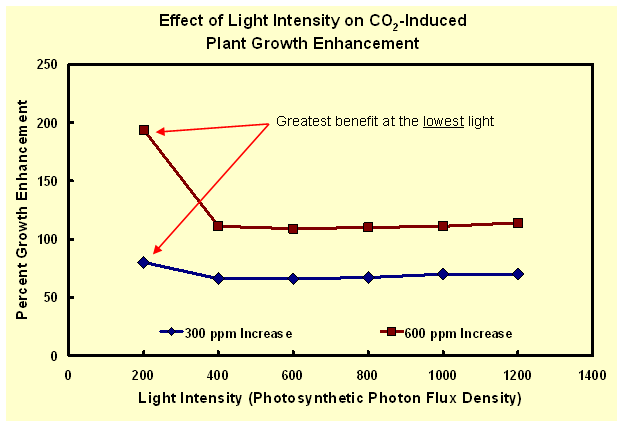
In Less-than Optimal Light Conditions, Higher CO2 Means More Plant Growth
In the case of light, Idso and Idso (1994) analyzed 37 CO2 enrichment experiments conducted over a ten year span in which plants were grown under both ideal and less-than-ideal light conditions. Results indicated that decreasing light intensity had no significant effect on plant photosynthetic response to atmospheric CO2 enrichment until the lowest light intensity of the 37 experiments studied was encountered. And at that point the photosynthetic stimulation provided by a 300-ppm increase in atmospheric CO2 actually rose, from 66% to 80%; while for a 600-ppm increase in CO2 it rose even further, from 111% to 194%, under the same circumstances.
(SEE IMAGE ABOVE)
Studies published subsequent to the review of Idso and Idso have continued to demonstrate that low light intensities do not negate the beneficial effects of atmospheric CO2 enrichment on plant growth and development. In fact, in a study of forest understory plants, Osborne et al. (1997) observed that elevated CO2 concentrations allowed for a positive net photosynthetic uptake of carbon on days and at locations that typically experienced light intensities so low that they were generally insufficient for positive net photosynthesis under current atmospheric CO2 concentrations. This consequence of atmospheric CO2 enrichment enabled the plants to live where they currently cannot due to a lack of sufficient light. Hence, Osborne et al. concluded that "the potential range of habitats that such species could occupy will expand considerably with rising atmospheric CO2."
One year later, Kerstiens (1998) analyzed the results of 15 previously published studies of trees having differing degrees of shade tolerance, finding that elevated CO2 caused greater relative biomass increases in shade-tolerant species than in shade-intolerant or sun-loving species. In fact, in more than half of the studies analyzed, shade-tolerant species experienced CO2-induced relative growth increases that were two to three times greater than those of less shade-tolerant species.
In an extended follow-up review analyzing 74 observations from 24 studies, Kerstiens (2001) reported that twice-ambient CO2 concentrations increased the relative growth response of shade-tolerant and shade-intolerant woody species by an average of 51 and 18%, respectively. Moreover, similar results were reported by Poorter and Perez-Soba (2001), who performed a detailed meta-analysis of research results pertaining to this topic, and more recently by Kubiske et al. (2002), who measured photosynthetic acclimation in aspen and sugar maple trees. Low light intensity, therefore, is by no means a roadblock to the benefits that come to plants as a consequence of an increase in the air's CO2 content.
Of course, most general rules do have their exceptions. In one such study, a 200-ppm increase in the air's CO2 concentration enhanced the photosynthetic rates of sunlit and shaded leaves of sweetgum trees by 92 and 54%, respectively, at one time of year, and by 166 and 68% at another time (Herrick and Thomas, 1999). Likewise, Naumburg and Ellsworth (2000) reported that a 200-ppm increase in the air's CO2 content boosted steady-state photosynthetic rates in leaves of four hardwood understory species by an average of 60 and 40% under high and low light intensities, respectively. Thus, even though these photosynthetic responses were significantly less in shaded leaves, they were still substantial, with mean increases ranging from 40 to 68% for a 60% increase in atmospheric CO2 concentration. And that's anything but shabby!
Under extremely low light intensities, the benefits arising from atmospheric CO2 enrichment may be small, but oftentimes they are very important in terms of plant carbon budgeting. In the study of Hattenschwiler (2001), for example, seedlings of five temperate forest species subjected to an additional 200 ppm of CO2 under light intensities that were only 3.4 and 1.3% of full sunlight exhibited CO2-induced biomass increases that ranged from 17 to 74%. Similarly, in the study of Naumburg et al. (2001), a 200-ppm increase in the air's CO2 content enhanced photosynthetic carbon uptake in three of four hardwood understory species by more than two-fold in three of the four species under light irradiances that were as low as 3% of full sunlight.
So, whether light intensity is high or low, or leaves are shaded or sunlit, when the CO2 content of the air is increased, so too are the various biological processes that lead to plant robustness also increased. Less than optimal light intensities, therefore, clearly do not negate the beneficial effects of atmospheric CO2 enrichment.
http://www.plantsneedco2.org/default.aspx?menuitemid=331&AspxAutoDetectCookieSupport=1
Friday, October 15, 2010
Grow Lights Toronto
Friday, September 17, 2010
Vertical Hydroponic system Vertical Hydroponic Grow System Toronto

Vertical Hydroponic Grow System Toronto

Hey folks, I just finished building a new model of Vertical Hydroponic system. It is more compact than all of my other build ups. I think it is also one of the most successful vertical hydroponic systems I built thus far.
Here is a few photos of it and a video.
If you have any questions on how to build one yourself, I will be happy to give you more detail on the build up.
This grwo system is designed for one grow light. 400 watt hps or 600 HPS grow light will work
well in this system.
Vertical Hydroponic Grow System Toronto
I also think a coolube will be good to use in it to keep plants cool. As soon as I get my hands on one
I will fit it in the system and will post an update.
Vertical Hydroponic Grow System Toronto Montreal
Vertical Hydroponic Grow System Toronto
Wednesday, September 8, 2010
VERTICAL GROWING VERTICAL GROW SYSTEMS DIY MONTREAL TORONTO CALIFORNIA CANADA VERTICAL HYDROPONICS VERTICAL HYDROPONIC SYSTEMS


Vertical growing method is the most efficient way to grow herbs and produce
indoors. Thought the concept has been around for quite a while, it is only recently that
it started to be implemented for commercial produce growing.
Vertical Hydroponic systems allows you to maximize yields by using both: space and
electricity more efficiently than conventional horizontal grow setups. This optimization of
resource use is achieved via application of several rather simple geometric concepts which
allow for the resources wasted in horizontal setups to be directed to do useful work.