Water Chillers, are they really better than A/C?
Lets hear what engineers have to say.
DIY water chiller from air conditioner (coming up)
WATER COOLED CO2 GENERATOR with a shower head?
Yes, SAVE $250 + (coming soon)
Friday, November 12, 2010

Circular drain pipe for DIY vertical hydroponic systems California


The bottom trays, the gutters, drain troughs are the MOST difficult part of building a DIY vertical hydroponic systems. I spent literally two years trying to invent a solution to
the circular drain troughs. I built square shaped systems, octagons, hexagons... finally spent hundreds of $ and countless days learning to bend 4"PVC pipes. Got quite good at it, eventually. And then one night making my way home pissed drunk, stumbled into
a construction site, and there it was! Hundreds of those pipes, already bent, with exactly 2' bend radius! DIYers paradise. Almost thought i was hallucinating for a while.
I'll tell you the secret:
you dont have to buy them from me, or from a hydroponic store, although I do know a place that deals them cheap retail.
They are called DB2 pipes. Come in grey PVC plastic and are quite hard to find, anywhere other than massive construction sites
not because they are not available, but rather thanks to particular mental imaging skills of most people working the counters of
construction material suppliers. I tried many times to convince guys in electrical supply and pipe stores, that such things do exist becasue I not only have seen them, but even "borrowed" a few here and there for the lack of other options. I drew them images of that
evasive part in the air with my hands, tried my best at verbal descriptions, until finally an old italian construction man got it and was able to produce them for me.
What you are looking for is called 4" DB2 Pipe 90 degree bend (or sweep) with 2 foot bend radius (translates into 4 foot diameter). Electrical supply stores should have them. Probably any construction supply store will be able to get them for you as long as you manage to convince them that such thing DOES in fact exist, which may at times, require borrowing belief inspiring techniques from the history of the great Spanish inquisition (bring pliers and blow torches).
These bends also come in 3 foot (36") bend radius, which is what I use for the AK-427 system. The sweeps come in quarter circle
shape. What I do is I glue end caps from home depot ($2,95 each) on the ends of each one and then (this is where it gets a bit tricky)
I cut each piece in half longitudinally, thus creating two quarter-circular troughs with half-end-cap at the end of each one.
These bends also come in 3 foot (36") bend radius, which is what I use for the AK-427 system. The sweeps come in quarter circle
shape. What I do is I glue end caps from home depot ($2,95 each) on the ends of each one and then (this is where it gets a bit tricky)
I cut each piece in half longitudinally, thus creating two quarter-circular troughs with half-end-cap at the end of each one.
NOTTA BENE:
GLUE End Caps FIRST!!! Then cut the pipe along its length. Otherwise it will be a hell trying to get the caps to stick to pipe. When pipe is cut it no longer maintains consistent precise diameter and getting it to form tight glued bond with end cap may require all 27.5 fingers exactly, which you probably dont have.
Tapping fittings into them is a no brainer. All in all you need only two quarter circle DB2 sweeps to complete the entire drain circle (each one, when
in half makes two) The entire cost: $25 per system. Three years it took slow me to figure this out.
As for the other parts, they are all $3 - $15 plastic Tee and L fittings from Home Depot
hydroponic store:) So there really is nothing at all in my systems that you cant just buy in Home Depot.
The PVC made vertical hydroponic systems I build from 2" white PVC
pipe, the one for central vacuum systems. The pipes come in 10 foot lengths and sell for $6,75 in Home Depot in Ontario and $2,95 in Quebec, while it is manufactured in Mississauga, Ontario... Go figure... Fitting for these you will find usually in ventilation section of HD or right next to the 2" vacuum pipe. Ls are $1,99 and Tees are $2,95. Attached is the photo of the central cross bar and components.
Email me if you have any questions.
PLEASE DO SHARE COMMENTS AND YOUR PROJECTS, LINKS, IDEAS.
Would also love to see photos of your projects. Lets put our experinces together and learn to build the best most efficient and cheap vertical hydroponic systems!
in half makes two) The entire cost: $25 per system. Three years it took slow me to figure this out.
As for the other parts, they are all $3 - $15 plastic Tee and L fittings from Home Depot
hydroponic store:) So there really is nothing at all in my systems that you cant just buy in Home Depot.
The PVC made vertical hydroponic systems I build from 2" white PVC
pipe, the one for central vacuum systems. The pipes come in 10 foot lengths and sell for $6,75 in Home Depot in Ontario and $2,95 in Quebec, while it is manufactured in Mississauga, Ontario... Go figure... Fitting for these you will find usually in ventilation section of HD or right next to the 2" vacuum pipe. Ls are $1,99 and Tees are $2,95. Attached is the photo of the central cross bar and components.
Email me if you have any questions.
PLEASE DO SHARE COMMENTS AND YOUR PROJECTS, LINKS, IDEAS.
Would also love to see photos of your projects. Lets put our experinces together and learn to build the best most efficient and cheap vertical hydroponic systems!
DIY Vertical Hydroponic Systems, building your own vertical hydroponic Systems california
I decided I'd post the build ups of my systems here for all you fellow DIY ers.
Hopefully, this might save you some time and effort in search of the easiest solutions.
I have been doing this for a while now, and might have a solution or two for the basic problems
we vertical system builders all run into.

HERE you will find the one MOST valuable (imho) solution of all, that I ever came up with:
How to make a circular gutter/drain pipe for a vertical hydroponic grow system.
DIY Cootube instructions.
HERE is are a few shots of the basic building blocks for my systems. NOTE: EVERYTHING i used
to build these vertical hydroponic systems is available in Home Depot or other material supplier stores. Nothing other than irrigation components was bought from hydroponic stores (read: overpaid for).
I SELL prebuilt complete vertical hydroponic systems as well. If you have tools, time, basic manual skills and space to build your own, you can save couple hundred dollars and use my plans oto build these systems yourself. Or you can BUY READY MADE vertical hydroponic systems from me. My mark ups are between $150 and $250 on top of what materials cost.
It may, actually, cost you less to just order from me. If you build yourself, I would greatly appreciate
you sharing photos, links, ideas etc with me either by mail, or even better right here in my BLOGG.
Good luck to all, and please do send me feedback!
Wednesday, November 3, 2010
Proposition 19 results british columbia economy
Proposition 19 vote will have effects on Canadian economy
Sunday, October 24, 2010
CO2 Generators for sale Toronto Montreal Canada Quebec

CO2 Generator for sale -------$265 CAD
Brand new.
2-15 cubic feet/hour capacity.
Propane powered.
Safety features:
Blow out sensor protection - will shut the gas off in case of the flame going out for any reason.
Tip over/fall over shut off.
Automatic ignition.
Can be used with any CO2 monitor CO2 controller.
Can be picked up in Toronto or Montreal.
Shipping available.
CO2 Generator WILL increase yields REGARDLESS of LIGHT intensity

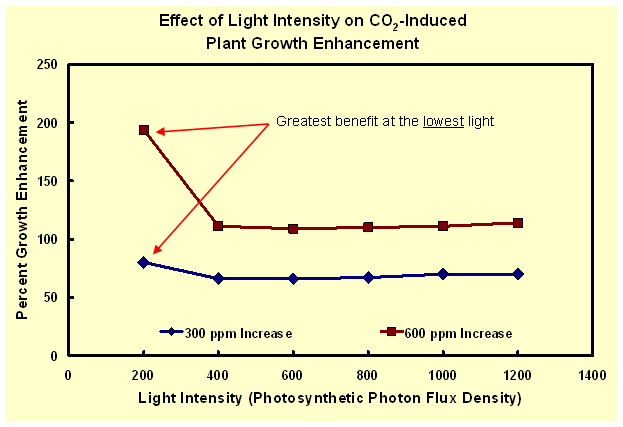
The common belief in hydroponic gardening circles is that CO2 enrichment of grow room atmosphere can increase yields
ONLY if the grow lights intensity is significantly increased compare to normal.
The following body of recent scientific studies of the subject matter show, that it is NOT SO!
According to the following study data, using CO2 generator or CO2 injection in hydroponic grow room WILL significantly stimulate plant photosynthesis regardless of whether the grow light
intensity is increased or remains the constant with addition of CO2 generator.
Enjoy the reading:
In Less-than Optimal Light Conditions, Higher CO2 Means More Plant Growth
In the case of light, Idso and Idso (1994) analyzed 37 CO2 enrichment experiments conducted over a ten year span in which plants were grown under both ideal and less-than-ideal light conditions. Results indicated that decreasing light intensity had no significant effect on plant photosynthetic response to atmospheric CO2 enrichment until the lowest light intensity of the 37 experiments studied was encountered. And at that point the photosynthetic stimulation provided by a 300-ppm increase in atmospheric CO2 actually rose, from 66% to 80%; while for a 600-ppm increase in CO2 it rose even further, from 111% to 194%, under the same circumstances.
(SEE IMAGE ABOVE)
Studies published subsequent to the review of Idso and Idso have continued to demonstrate that low light intensities do not negate the beneficial effects of atmospheric CO2 enrichment on plant growth and development. In fact, in a study of forest understory plants, Osborne et al. (1997) observed that elevated CO2 concentrations allowed for a positive net photosynthetic uptake of carbon on days and at locations that typically experienced light intensities so low that they were generally insufficient for positive net photosynthesis under current atmospheric CO2 concentrations. This consequence of atmospheric CO2 enrichment enabled the plants to live where they currently cannot due to a lack of sufficient light. Hence, Osborne et al. concluded that "the potential range of habitats that such species could occupy will expand considerably with rising atmospheric CO2."
One year later, Kerstiens (1998) analyzed the results of 15 previously published studies of trees having differing degrees of shade tolerance, finding that elevated CO2 caused greater relative biomass increases in shade-tolerant species than in shade-intolerant or sun-loving species. In fact, in more than half of the studies analyzed, shade-tolerant species experienced CO2-induced relative growth increases that were two to three times greater than those of less shade-tolerant species.
In an extended follow-up review analyzing 74 observations from 24 studies, Kerstiens (2001) reported that twice-ambient CO2 concentrations increased the relative growth response of shade-tolerant and shade-intolerant woody species by an average of 51 and 18%, respectively. Moreover, similar results were reported by Poorter and Perez-Soba (2001), who performed a detailed meta-analysis of research results pertaining to this topic, and more recently by Kubiske et al. (2002), who measured photosynthetic acclimation in aspen and sugar maple trees. Low light intensity, therefore, is by no means a roadblock to the benefits that come to plants as a consequence of an increase in the air's CO2 content.
Of course, most general rules do have their exceptions. In one such study, a 200-ppm increase in the air's CO2 concentration enhanced the photosynthetic rates of sunlit and shaded leaves of sweetgum trees by 92 and 54%, respectively, at one time of year, and by 166 and 68% at another time (Herrick and Thomas, 1999). Likewise, Naumburg and Ellsworth (2000) reported that a 200-ppm increase in the air's CO2 content boosted steady-state photosynthetic rates in leaves of four hardwood understory species by an average of 60 and 40% under high and low light intensities, respectively. Thus, even though these photosynthetic responses were significantly less in shaded leaves, they were still substantial, with mean increases ranging from 40 to 68% for a 60% increase in atmospheric CO2 concentration. And that's anything but shabby!
Under extremely low light intensities, the benefits arising from atmospheric CO2 enrichment may be small, but oftentimes they are very important in terms of plant carbon budgeting. In the study of Hattenschwiler (2001), for example, seedlings of five temperate forest species subjected to an additional 200 ppm of CO2 under light intensities that were only 3.4 and 1.3% of full sunlight exhibited CO2-induced biomass increases that ranged from 17 to 74%. Similarly, in the study of Naumburg et al. (2001), a 200-ppm increase in the air's CO2 content enhanced photosynthetic carbon uptake in three of four hardwood understory species by more than two-fold in three of the four species under light irradiances that were as low as 3% of full sunlight.
So, whether light intensity is high or low, or leaves are shaded or sunlit, when the CO2 content of the air is increased, so too are the various biological processes that lead to plant robustness also increased. Less than optimal light intensities, therefore, clearly do not negate the beneficial effects of atmospheric CO2 enrichment.
http://www.plantsneedco2.org/default.aspx?menuitemid=331&AspxAutoDetectCookieSupport=1
Friday, October 15, 2010
Grow Lights Toronto
Just found a supplier of digital ballasts grow lights in Toronto at wholesale prices.
The company is selling digital ballast grow lights switchable MH/HPS at very competitive rates.
I just picked up a couple digital ballast grow lights in Toronto from them for my customers.
400 watt digital ballast grow light kit with two bulbs MH/HPS for $140
600 Watt digital ballast with two bulbs and reflector MH/HPS for $200
1000 Watt grow light digital ballast kit toronto MH/HPS for $280 I beleive.
Great value recommended.
The prices charged at Toronto Grow Shops for hydroponic equipment are exagerated,
considering that the equipment itself comes all from the same factories in China.
The only difference really is marketing and bran labels glued onto those digital ballasts imported by the more popular better advertised brand name toronto hydroponic supplies stores.
The actual source is China for all of these products.
You can pick up these grow lights in Toronto from Growlux Hydroponic Equipment.
Subscribe to:
Posts (Atom)